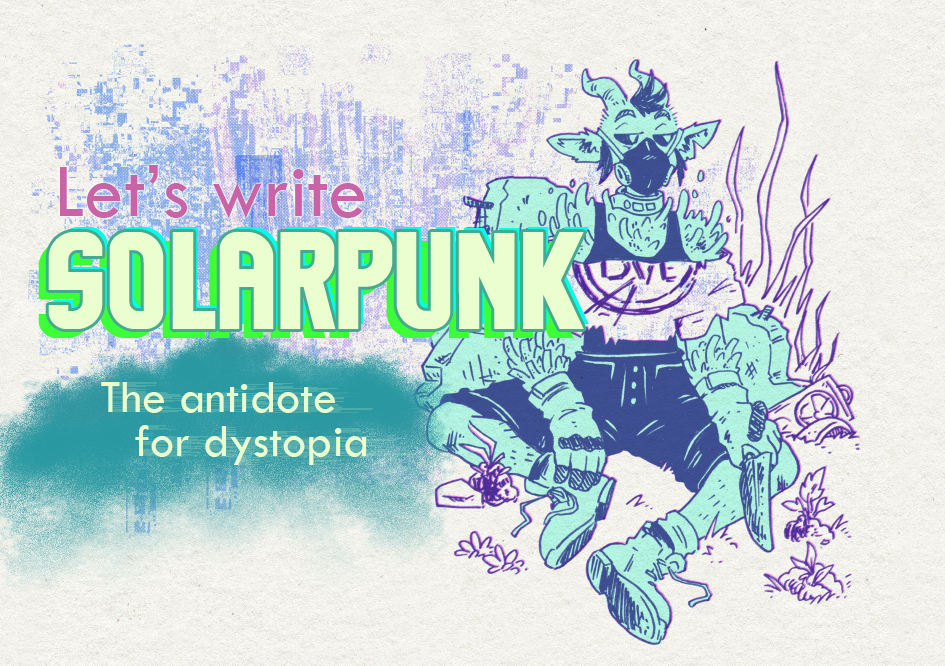
Talk on writing Solarpunk comics presented to Cartoonists United. This is the page for notes, links and resources of that talk. The talk will be embedded here when it is available publicly.
Solarpunk as a genre term is still fairly recent, and started to get mainstream understanding (as a term) only in the last 3-5 years.
So What is Solarpunk?
Both a literary genre and a social movement
Seeks to enable a solarpunk future
It's distinct from (and much more than) "cottagecore aesthetic". It isn't necessarily Utopian or Post-Apocalyptic. It's under the umbrella term of "Hope Punk" and "Cli Fi".
3 key tests:
The three key tests jam uses to determine whether a work is solarpunk:
The work presents an optimistic view of the future (hopeful narrative)
It features people working together to overcome problems.
With a strong emphasis on ecological themes. (Either during the climate transition, after a major climate disaster, or a future where we live in balance with the ecosystem).
Definition is not strict, more of a "lens" to see what is more or less aligned.
Why should we write SolarPunk?
It is an act of creating culture, a culture we'll need to get through our current crisis.
Stories Lead Thoughts, thoughts guide action.
Showing people alternatives to capitalism is the first step to fighting it.
Building the "I want to go to there" feelings.
Even if imperfect, fiction can present ideas that the reader can examine and reflect on.
Fiction can help them visualize systems and processes that may not yet be manifest.
Fiction can help to normalize concepts, terms and ideas common in the movement.
Fiction is a form of "soft prefiguration". Demonstrates what living and working in that way could be like.
Examining "the Water"
To write SolarPunk, the writer should take some time to reflect on the concepts and assumptions they were raised with, and do some unpacking within themselves of harmful concepts that must be left behind such as:
White supremacy (and things that come out of it: patriarchy, gender essentialism, racism and ableism).
Colonialims and ideas of "man's dominion over nature"
Capitalism
Consumerism
Social Technologies
The most critical thing that fiction can demonstrate are the many social technologies that will be critical to develop as we transition the culture. As examples:
Library economies
Different methods of organizing (vs only hierarchical)
Different methods of decision making (e.g. "7 Generations" principle)
Customs and Norms (e.g. "Responsible Foraging", and the "Leave No Trace" custom)
Holidays and Events (e.g. "Invasive Cleanup Days", and "Repair Fairs")
Brining in Social Technologies
There are already a lot of great works of fiction that model positive social interactions. As examples:
The ideas presented here may still seem a bit basic, but people still struggle with them. Transitioning to a positive climate future will also require being able to grapple with much more complex emotions and ideas such as:
Dealing with more subtle forms of loss and grief, such as the loss of the climate we used to know, our ways of life, our nations or entire towns.
Processing the trauma of climate disaster
Healthy disagreement and conflict, especially when the stakes are existential
Very different people working together effectively - especially as we are learning completely new ways of organizing. Processing what we must leave behind to go forward.
Aligned Media
More examples of great comics/media that aren't SolarPunk but are aligned with these ideas especially for social technologies: